

Amarillo (#B88A00)

Amarillo (#ffd966)

Accesible AA: #B88A00

Genomic Medicine

Genomic Medicine

The Genomic Medicine Unit aims to implement whole-genome sequencing (WGS) technology within the public healthcare network as a clinical, research, and development tool associated with precision medicine in Navarra. Originating from research projects funded by the Department of Industry of the Government of Navarra, this group consists of internal resources (Principal Investigators, postdoctoral researchers, genetic counselors, and research support technicians), clinical experts, as well as staff from other Units, Platforms, and project advisors. It currently maintains several main lines of research. 

Research lines:

  • Identification of new genes and/or genetic variants causing genetically based pathology in patients with rare diseases. 
  • Identification of genomic alterations with a high clinical, diagnostic, prognostic, and therapeutic impact, as well as predictors of personal and reproductive risk. 
  • Identification of genomic variants that modify drug response.
  • Efficiency evaluation of population-based personalized prevention programs.
  • Development of new bioinformatics analysis tools for the implementation of healthcare-focused genomic analysis within Healthcare Systems (in collaboration with the Bioinformatics Unit). 
  • Development of a genomic data ecosystem for its secondary and primary reuse.
Investigador principal
Área de investigación
Genomic Medicine
Implementing whole genome sequencing methods for analysing entire genomes
Actualidad

Navarrabiomed launches NAGENCOL, an initiative to use whole-genome sequencing to offer patients with hypercholesterolemia personalised treatment to avoid coronary events
Author
Navarrabiomed

High-cholesterol levels, or hypercholesterolemia, affects nearly 1500-2500 people in Navarra, and less than 20 per cent of them are not aware that they suffer from this condition. Hypercholesterolemia is considered to cause 22 per cent of coronary events, most of which could be prevented with early diagnosis and treatment. The biomedical research centre Navarrabiomed has launched NAGENCOL, a project to address this issue using whole-genome sequencing as a diagnostic tool to offer personalised treatment to patients who suffer from hypercholesterolemia. The project is framed within NAGEN, a global strategy aimed at applying genomic medicine in the Navarra Health System-Osasunbidea (SNS-O).

Currently, hypercholesterolemia poses a real challenge to the public health system, because the life expectancy of untreated patients can decrease by 25 years, and 50 per cent of them are more likely to have a heart attack before the age of 55. NAGENCOL addresses this problem, offering a new model that uses genomic information, together with other clinical and demographic data, to bring precision medicine to individual patients.

This ambitious public health project has a budget of 2 million Euro, contributed by the Department of Economic Development at the Directorate-General for Industry, Energy and Innovation of the Government of Navarra, within the framework of the Genomics and Advanced Medicine project (GEMA) and the Intelligent Specialisation Strategy S3.

The NAGENCOL activities are managed by five strategic partners specialising in clinical practice, scientific and technical services, and research. They include the Navarra Hospital Complex (CHN), Nasertic, Tracasa Instrumental SL and Navarrabiomed as the leader of the study. The project is headed by Dr Ander Ernaga and Dr Juan Pablo Martínez from the Endocrinology Service at CHN.

NAGEN Strategy

Since 2016, Navarrabiomed has been leading the Genomic Medicine Strategy (NAGEN) of the Navarra Health System-Osasunbidea. With the support of the Government of Navarra, Navarrabiomed has since coordinated two strategic projects: NAGEN 1000 (best precision medicine project award winner in 2018) and Pharmanagen.

The two initiatives, along with NAGENCOL, are being used to set up, in the SNS-O patient care units, the infrastructure required for using genomic data as a powerful diagnostic tool and to determine the best personalised treatment for each patient.
Categoría
Galería de imágenes
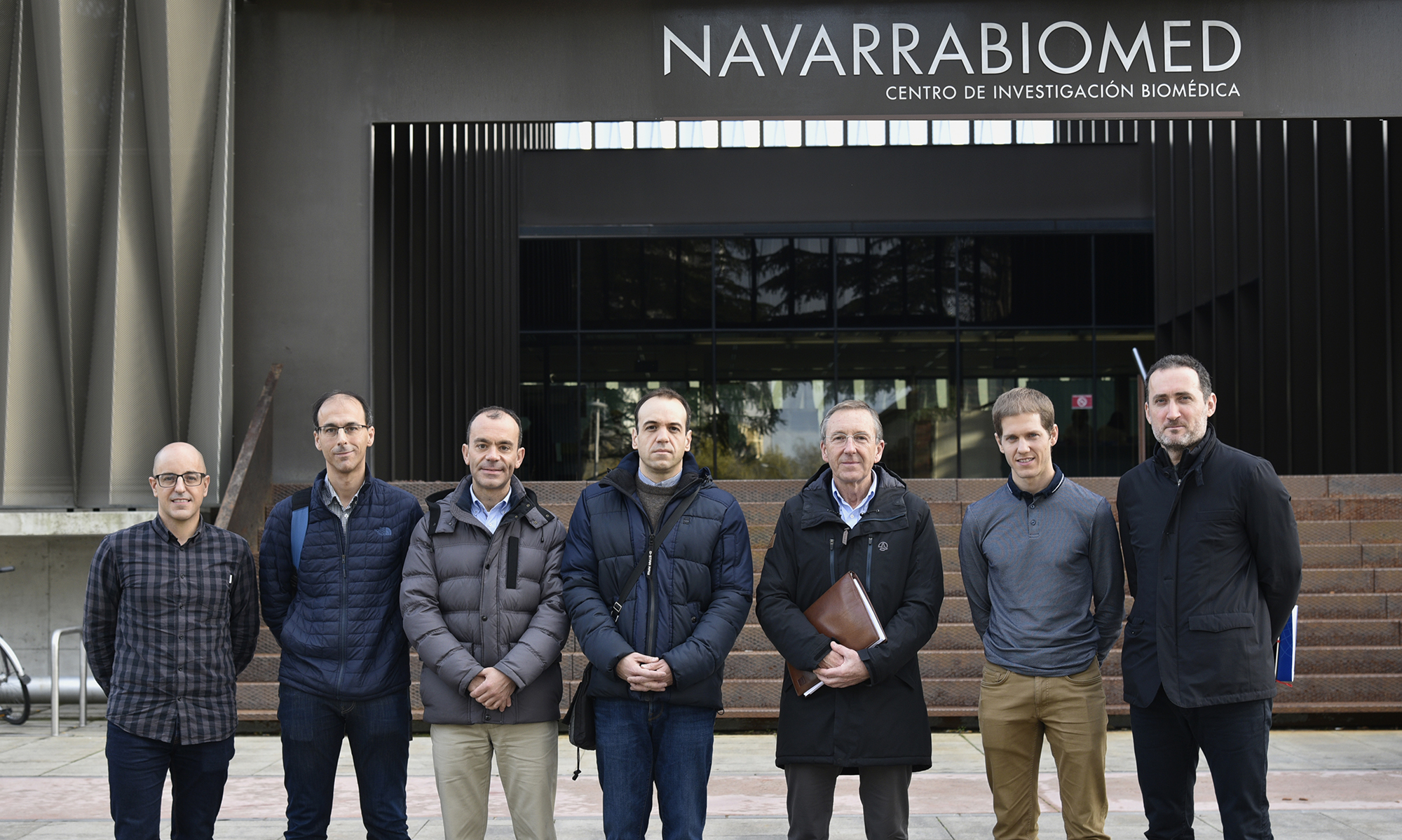
Jorge Marín (Navarrabiomed); Juan Pablo Martínez (CHN); Gonzalo Etayo (Nasertic); Jorge Jiménez (Nasertic); Roberto Clerigué (iTracasa); Mikel Galar (UPNA) and Carlos Aranda (iTracasa).
Download Flecha que indica descarga
Documentación
Vídeo

NAGEN 1000: diagnosis of rare genetic disorders through whole genome sequencing
Author
Navarrabiomed

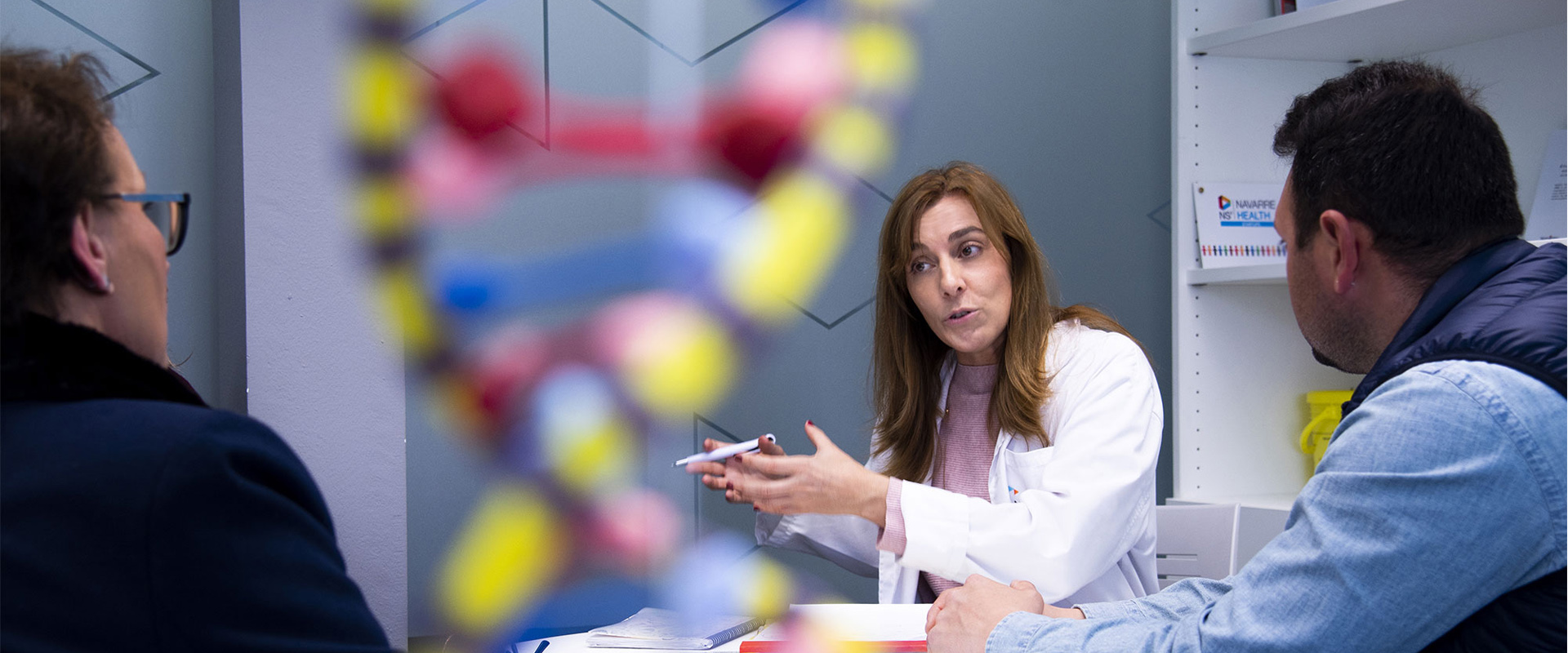
Navarrabiomed has led the NAGEN: Navarra Genome 1000 project since 2016. The project focuses on whole genome sequencing for a new approach to rare genetic disorders in the Navarra Health System-Osasunbidea (SNS-O). So far, thanks to collaboration with doctors from 18 medical specialties at the Navarra Hospital Complex (CHN), the study includes data about 400 patients and their relatives, precise diagnoses for 25 per cent patients and identification of possible causes for another 25 per cent.

The patients that are part of the study had not been accurately diagnosed, despite having been treated by several specialists and having taken a large number of traditional tests. Angel Alonso, the coordinator of the project, highlighted the project’s relevance to healthcare services: ‘Making genomic analysis available to the public health system is revolutionary. It means a significant change in the clinical approach to patients with rare genetic disorders.’

Impact on the patient and their family

On the occasion of Rare Disease Day on the last day of February, it is worth mentioning that about 6 per cent of the global population are individuals with rare diseases. In Navarra, their number amounts to 38,000. At present, there are 7000 types of rare diseases, most of them of genetic origin.

In many cases, genetic testing enables the patient and their family to get a deeper knowledge of their condition and its progression, to understand how a genetic disease is inherited and to learn about the risks for other family members. The emotional significance of finding answers to the questions posed by the symptoms – which sometimes have remained unanswered for too long – means putting an end to uncertainty and isolation for most patients with rare diseases.

NAGEN 1000: a pioneering project in Spain

NAGEN 1000 is a ground-breaking project at the national level, placing Navarra at the forefront of genomic analysis and technology. The project was introduced last year at the Senate Presentation of Genomic Studies, whose conclusions were approved in 2019, thus green-lighting the development of a national strategy for personalised medicine.

Currently, the project’s methods, procedures and infrastructure are being transferred to daily clinical practice in SNS-O, to the benefit of the people of Navarra.

NAGEN 1000 is financed by the Economic Development Department at the Directorate-General for Industry, Energy and Innovation within the framework of the Intelligent Specialisation Strategy S3. It is being developed by a consortium made of CHN, Nasertic (a company run by the Government of Navarra), Avantia and Navarrabiomed, leader and coordinator of the project, with the support of the Directorate-General for Information Technology, Telecommunications and Public Information (DIGITIP), and the cooperation of the Centro Nacional de Análisis Genómico (CNAG-CRG) and the Clinical Bioinformatics Research Area into Rare Diseases (CIBERER) of Instituto de Salud Carlos III (ISCIII).
Categoría
Vídeo
Documentation
Folleto
ReproNAGEN Análisis personalizado de fertilidad
Folleto
NagenMX Prevención personalizada
Folleto
NAGENpediatrics
Folleto
NAGEN 1000
Vídeo
Nagen 1000
Nagen 1000
Ángel
Alonso Sánchez
Head of the Unit
Colaboradores/as
Anda Apiñaniz, Emma
Servicio de Endocrinología y Nutrición, CHN
Armendariz, Yolanda
Servicio de Pediatría, CHN
Artigas López, Mercedes
Servicio de Genética Médica, CHN
Aznal, Elena
Servicio de Pediatría, CHN
Bandrés Elizalde, Eva
Servicio de Hematología, CHN
Bartolomé, Javier
Servicio de Atención Primaria
Basturce Elorz, Mª Teresa
Servicio de Carciología, CHN
Bengoa, Amaya
Servicio de Genética, CHN
Celaya, Concepción
Subdirección de Farmacia
Cuesta Zorita, Manuel Jesús
Servicio de Psiquiatría, Salud mental
Curi Chercoles, Sergio Miguel
Servicio de Neumología, CHN
De la Cruz Sánchez, Susana
Servicio de Oncología Médica, CHN
Erviti, Juan
Innovación SNS-O
Fanlo Mateo, Patricia
Servicio de Medicina Interna, CHN
Gorría, Nerea
Servicio de Pediatría, HUN
Guerra Lacunza, Ana
Servicio de Aparato Digestivo, CHN
Gutiérrez, Marta
Innovación SNS-O
Hualde, Josune
Servicio de Pediatría, HUN
Ibáñez Bosch, Rosario
Servicio de Endocrinología y Nutrición, CHN
Lavilla, Ana
Servicio de Pediatría, CHN
Leache, Leire
Innovación SNS-O
Molinuevo Ruiz de Zarate, José Ignacio
Servicio de Oftalmología, CHN
Montes Díaz, Marta
Servicio de Anatomía Patológica, CHN
Moreno, María
Servicio de Genética, CHN
Navarro, Adela
Servicio de Cardiología, CHN
Otamendi, Ana
Servicio de Atención Primaria
Purroy Irurzon, Carolina Eugenia
Servicio de Nefrología, CHN
Rupérez, Eva
Servicio de Pediatría, CHN
Sáez de Ocáriz, Ana
Servicio de Radiología Intervencionista
Sagaseta de Ilurdoz Uranga, Mª Josefa
Servicio de Pediatría, CHN
Saiz, Luis Carlos
Innovación SNS-O
Salgado Garrido, Josefa
Complejo Hospitalario de Navarra
Santesteban Muruzabal, Raquel
Formación Sanitaria Especializada A.P., Atención Primaria
Vicuña, Miren
Digestivo
Viguria, Mª Cruz
Servicio de Hematología
Yoldi Petri, Mª Eugenia
Servicio de Pediatría, CHN
Zubicaray Ugarteche, José Jacinto
Servicio de Otorrinolaringología, CHN
Zudaire, Maite
Servicio de Hematología
Zabaleta Jurio, Jesús
Servicio de Obstetricía y Ginecología, HUN
Unidad de investigación / Grupo Vinculado
Contacto
Genomic Medicine

Navarrabiomed - Centro de investigación biomédica
Complejo Hospitalario de Navarra, edificio de investigación.
Calle Irunlarrea, 3. 31008 Pamplona, Navarra, España. 
No mostrar en listados de Unidades de Investigación
Off

Molecular Pathology of Cancer

Molecular Pathology of Cancer

The Cancer Molecular Pathology Research Unit is composed of researchers from Navarrabiomed and clinical researchers from the Pathology Department, Surgery and other services at the University Hospital of Navarra. Its fundamental objective is the detection of new genetic and epigenetic biomarkers related to prognosis and response to oncological treatment in patients with different types of cancer, mainly breast cancer, colorectal cancer, gynecological cancers, and brain tumors among others. For this, we use massively parallel sequencing (NGS) on tissue and liquid biopsy, as well as single-gene molecular techniques such as pyrosequencing, real-time PCR, etc.

The unit collaborates with other research groups at Navarrabiomed and at other institutions (IUOPA, Oviedo; PEBC-IDIBELL, Barcelona).


Research lines:

  1. Analysis of aberrant methylation (hypo- and hypermethylation) and presence of alterations (mutations, indels, copy number variations, fusions) in genes involved in the progression of solid tumors.
  2. Analysis of the prognostic and predictive value of these biomarkers for response to oncological treatment.
  3. Analysis of protein expression profiles in relation to tumor characteristics.
  4. In vitro functional assays.


Investigador principal
Equipo de investigadores
Área de investigación
Oncology
Molecular Pathology of Cancer
Actualidad

Saioa Mendaza Lainez defenderá su tesis doctoral el martes, 30 de junio

Author
Navarrabiomed

Saioa Mendaza Lainez, investigadora predoctoral en la Unidad de Patología Molecular del Cáncer de Navarrabiomed, realizará la lectura de su tesis doctoral por la Universidad Pública de Navarra el martes 30 de junio, a las 11:30, a través de videoconferencia en Navarrabiomed (solamente podrán acudir aquellas personas autorizadas previamente). 

La tesis, titulada Approaching the epigenome of triple-negative breast cancer to identify new biomarkers, ha sido desarrollada en Navarrabiomed bajo la dirección del Dr. David Guerrero Setas y la Dra. Esperanza Martín Sánchez.


El cáncer de mama es la neoplasia más frecuente en mujeres a nivel mundial y la primera causa de muerte por cáncer en este mismo sexo. La investigación aborda el cáncer de mama triple negativo (CMTN), un subtipo que a diferencia del resto carece de tratamiento dirigido, lo que conlleva consecuencias más agresivas en las personas que lo padecen. Esto hace que a día de hoy, la búsqueda de nuevos biomarcadores y dianas terapéuticas para esta enfermedad sea imprescindible.

Dado que las alteraciones epigenéticas están involucradas en la tumorigénesis, el objetivo de esta tesis ha sido caracterizar la metilación del DNA y la acetilación de histonas de este tipo de cáncer. Con ello se ha buscado identificar nuevas firmas potencialmente diagnósticas y pronósticas, así como alteraciones destinatarias de fármacos dirigidos.

Los resultados de esta caracterización han permitido concluir que el patrón epigenético está alterado en CMTN respecto a tejido mamario no neoplásico. Más importante aún, la investigación ha desvelado dos alteraciones epigenéticas específicas como potenciales biomarcadores de peor pronóstico: la acetilación de la histona H4K5 y la hipometilación del gen ADAM12, el cual se presenta también como posible diana terapéutica frente a este cáncer.

Asimismo, se ha identificado una nueva firma basada en metilación de DNA con utilidad diagnóstica. Por último, se han descrito los procesos biológicos de los distintos genes regulados por la acetilación de H4K6 en líneas celulares no neoplásicas y CMTN.

El trabajo realizado ha dado lugar a tres publicaciones científicas y ha sido difundido en dos congresos consecutivos de European Association for Cancer Research; uno celebrado en Manchester en el año 2017 y en Amsterdam en el 2018.

Para el desarrollo de la tesis Saioa Mendaza ha sido beneficiaria de dos becas: Ayudas para la formación de Personal Investigador de la Univesidad Pública de Navarra  para la realización de tesis doctorales y Beca a la excelencia de la Funcación Caja Navarra para la realización de una estancia en University of Massachussets Medical School (EEUU).

Categoría
Vídeo
Colaboradores/as
Amat Villegas, Irene
Hospital Universitario de Navarra
Armendáriz Rubio, Pedro
Hospital Universitario de Navarra
Arriola Osés, Marta
Hospital Universitario de Navarra
Córdoba Iturriagagoitia, Alicia
Hospital Universitario de Navarra
Guarch Troyas, Rosa
Hospital Universitario de Navarra
Ruiz de Azua Ciria, Ana Yerani
Hospital Universitario de Navarra
Zazpe Cenoz, Idoya
Hospital Universitario de Navarra
Unidad de investigación / Grupo Vinculado
Contacto
Molecular Pathology of Cancer

Navarrabiomed - Centro de investigación biomédica
Complejo Hospitalario de Navarra, edificio de investigación.
Calle Irunlarrea, 3. 31008 Pamplona, Navarra, España. 
No mostrar en listados de Unidades de Investigación
Off