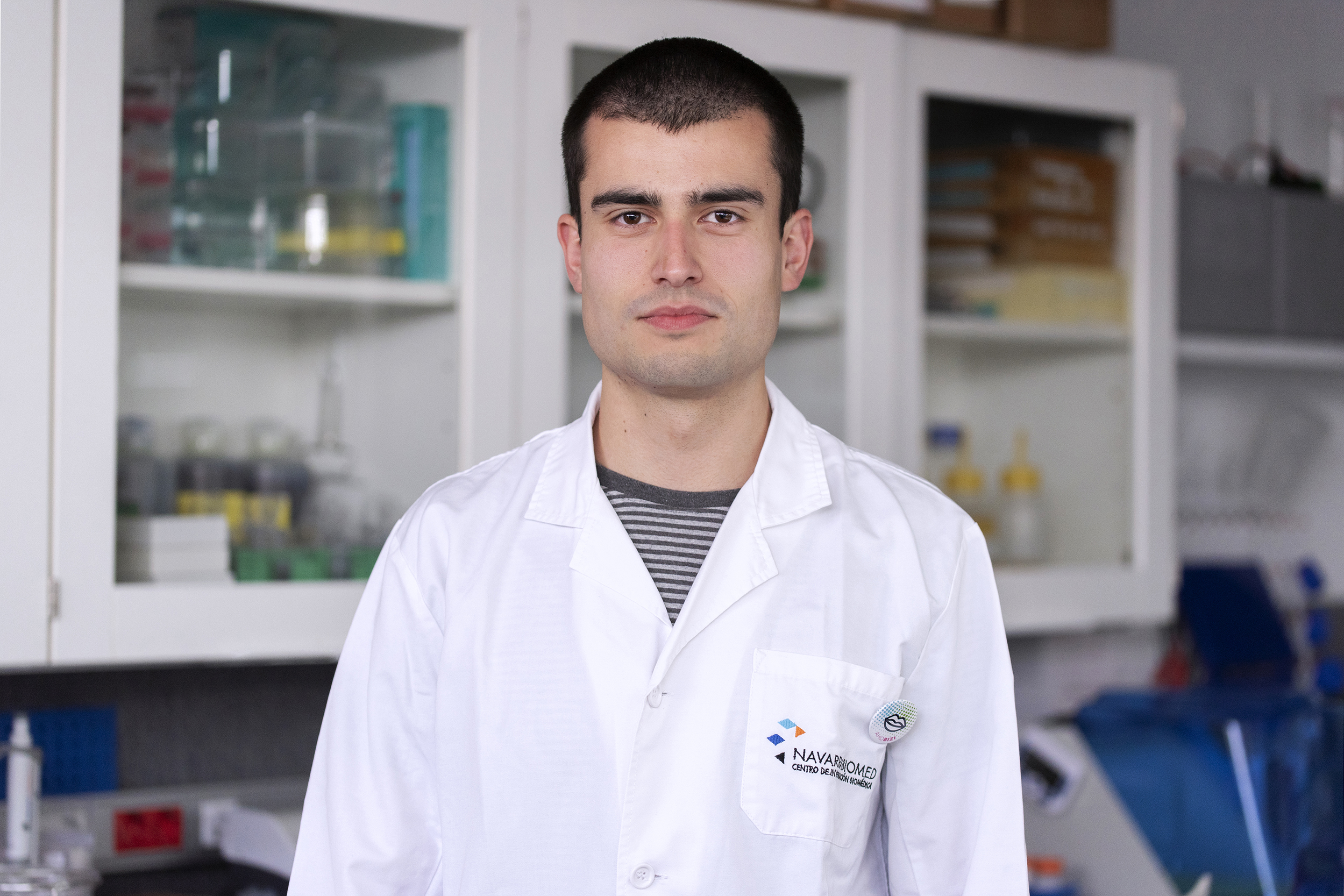

Mattie Garaikoetxea Investigates the Effectiveness of Certain Drugs in Chronic Aortic Regurgitation and Why the Disease Affects Men More Than Women
The doctoral research was carried out at the Translational Cardiology Unit of Navarrabiomed.
Biochemist Mattie Garaikoetxea Zubillaga has explored several aspects of chronic aortic regurgitation in his doctoral thesis, defended at the Public University of Navarre (UPNA). Chronic aortic regurgitation is a degenerative cardiovascular disease characterized by the inadequate closure of the aortic valve and occurs more frequently in men. Specifically, his research examined, on the one hand, sex-related differences in valvular interstitial and endothelial cells, and on the other, the potential benefits of mineralocorticoid receptor antagonism, a type of pharmacological treatment.
The research was conducted at the Translational Cardiology Unit of Navarrabiomed under the supervision of Natalia López Andrés, principal investigator of the unit, and Eva Jover García, head of the unit’s Arrhythmias research line.
As noted, chronic aortic regurgitation is a degenerative cardiovascular disease defined by the inadequate sealing of the aortic valve, resulting in an abnormal backward flow of blood from the aorta into the left ventricle of the heart. The prevalence of its most severe form is estimated at 1.6% of the Western population over the age of 65, and it is diagnosed three times more frequently in men.
Currently, there is no effective pharmacological treatment capable of slowing, halting, let alone reversing the disease. As a result, progression toward heart failure can only be prevented through surgery. “These interventions entail significant economic and socio-healthcare costs, making it essential to identify new therapeutic targets and effective drugs that could prevent disease progression,” explains the researcher.
Against this backdrop, the doctoral thesis had a dual objective. First, to analyze sex-related differences at the molecular and cellular level, considering the marked disparity in disease prevalence between men and women. Second, to investigate the role of the mineralocorticoid receptor protein in the development of the disease and assess its pharmacological blockade as a potential therapeutic strategy.
The study included a cohort of 144 patients, who donated serum samples and aortic valve tissue following surgery. “Using this tissue, we were able to analyze both gene and protein expression in the cells that make up the aortic valve, namely valvular interstitial cells and valvular endothelial cells,” explains the author.
Differences Between Men and Women
The findings showed that valvular interstitial cells from men and women undergoing surgery for chronic aortic regurgitation differ significantly. “Cells from male patients are more prone to developing fibrotic and inflammatory processes, whereas cells from female patients appear to be healthier,” the researcher notes. “The role of valvular endothelial cells was also examined, although sex-related differences were much more limited,” he adds.
The thesis further demonstrated that the mineralocorticoid receptor is present in the aortic valves of patients with chronic aortic regurgitation, with higher expression levels observed in male patients. Moreover, receptor expression was associated with increased levels of both inflammatory and fibrotic mediators. In other cardiovascular diseases, pharmacological blockade of this receptor, using drugs already employed in routine clinical practice in Spanish hospitals, has yielded substantial clinical benefits. “In line with these findings, we demonstrated that, at both the cellular and molecular levels, blocking this receptor prevents the pro-fibrotic and pro-inflammatory effects of its activation, processes that are associated with the development of aortic regurgitation,” explains Garaikoetxea. “Furthermore, aortic valves from patients who were receiving this type of medication for other conditions showed lower expression of inflammatory and fibrotic markers.”
Overall, the research has demonstrated for the first time that, at the cellular level, men exhibit greater activation of fibrotic and inflammatory pathways, as well as higher mineralocorticoid receptor expression, in the context of chronic aortic regurgitation. By contrast, cells from women display less pronounced or comparatively healthier processes, suggesting differences in the disease’s pathophysiology and progression between sexes. “The clinical implications of the sexual dimorphism currently observed in this disease will be investigated in future studies by our research group,” says Mattie Garaikoetxea.
“Finally, molecular-level benefits of mineralocorticoid receptor antagonism have been observed, opening the door to future studies that could confirm the therapeutic value of these drugs in chronic aortic regurgitation and potentially support their repositioning for this indication,” he concludes.
Brief CV of Mattie Garaikoetxea
Mattie Garaikoetxea holds a Bachelor’s Degree in Biochemistry from the University of Navarra and a Master’s Degree in Health Sciences Research from UPNA. He received a Navarrabiomed fellowship to carry out his doctoral research. The results of his work were recently presented at the Heart Valve Society Annual Meeting 2025 in Cairo, Egypt, under the title “Sex Differences in Aortic Valve Inflammation and Remodeling in Chronic Severe Aortic Regurgitation.” During his PhD, he also completed a research stay at the Centre de Recherche des Cordeliers in Paris.
He is the author of 17 scientific articles published in international journals and has presented research at around 30 national and international medical conferences. In addition, he has participated in six research projects funded by IdiSNA or Navarrabiomed.