
Aptitude Proxi Scientific Conference Examines How Research and Community-Based Prevention Contribute to Healthy Ageing
- Health Minister Fernando Domínguez highlights the need to anticipate frailty and strengthen older adults’ autonomy through community-based care.
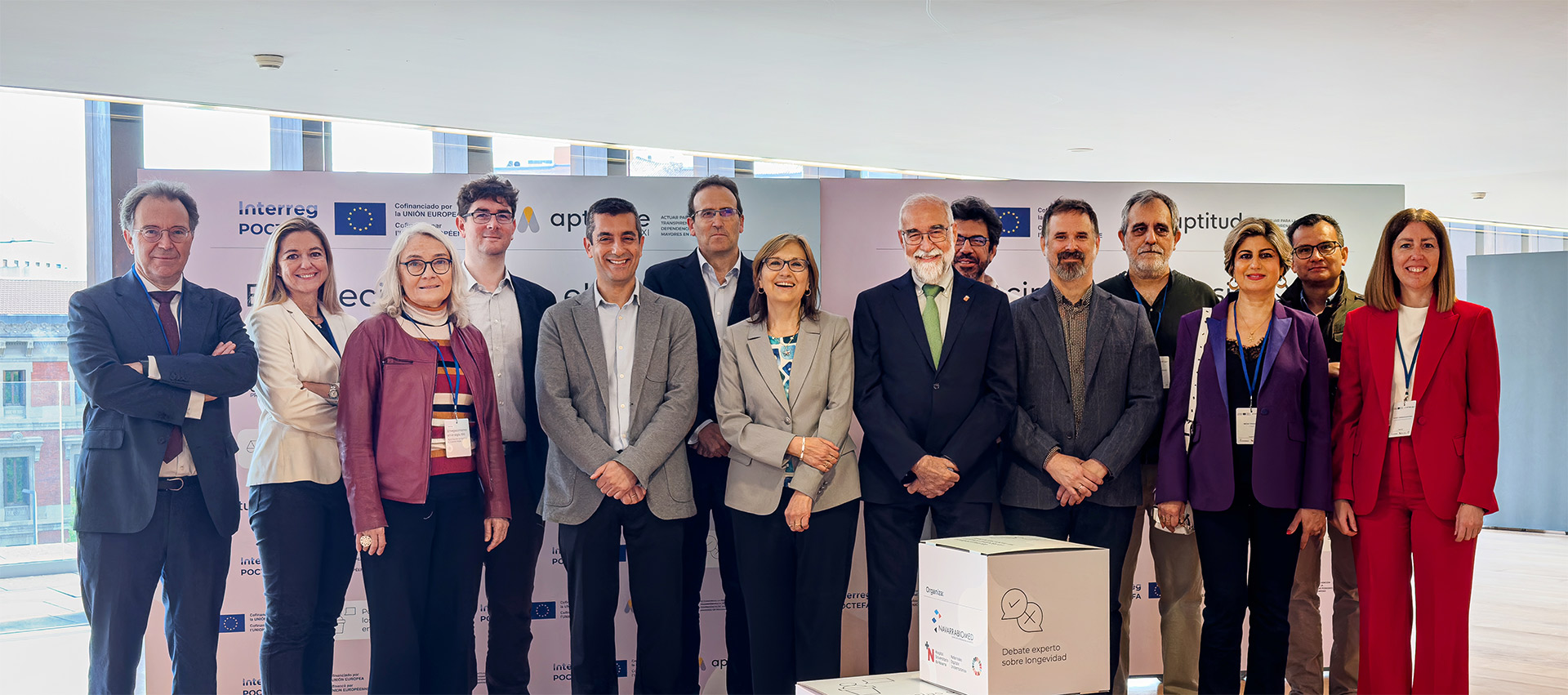
Population ageing and the challenges it poses for today’s societies and healthcare systems were the focus of the scientific conference “Ageing in the 21st Century: Contributions from Science, New Challenges,” held today and organized by Navarrabiomed within the framework of the cross-border project Aptitude Proxi. The event explored the role of research and innovative preventive models in improving the quality of life and autonomy of older adults.
The conference was opened by Fernando Domínguez, Minister of Health of the Government of Navarre, accompanied by Nicolás Martínez, representing the University Hospital of Navarra–Navarrabiomed–IdiSNA, and Marina Pollán, Director of the Carlos III Health Institute.
During his address, the Minister stated that:
“Ageing is one of the major challenges facing our societies and encourages us to move towards a healthcare system that prioritizes prevention, proximity, and research, shifting from a disease-centered approach to one focused on anticipation, care, and prevention, as has been promoted through the Aptitude Proxi cross-border project.”
He also emphasized the importance of advancing toward a more preventive healthcare model, capable of detecting frailty at an early stage, strengthening autonomy, and promoting active and healthy ageing.
“The goal is not only to live longer, but to live better, with quality of life and independence,” he said.
Scientific Content of the Conference
The conference highlighted the importance of combining research, healthcare, and community action to advance a more human-centered, preventive, and accessible model of care capable of addressing the challenges of ageing in the 21st century.
The scientific programme addressed, from a multidisciplinary perspective, the main advances and challenges in the field of ageing, with presentations focused on frailty, functional capacity, prevention, health promotion, and the translation of scientific knowledge into clinical practice.
Throughout the different sessions, researchers and healthcare professionals presented research findings and innovative experiences aimed at improving the early detection of risk situations, optimizing care for older adults, and advancing toward more comprehensive, personalized, and evidence-based intervention models.
The event also served as a platform for dialogue among professionals from the fields of research, hospital care, and primary care, strengthening collaboration and facilitating knowledge transfer.
Aptitude Proxi: Prevention and Active Ageing Through Community-Based Care
One of the conference’s central themes was the analysis of the European project Aptitude Proxi, a cross-border cooperation initiative developed under the Interreg POCTEFA programme. Its objective is to prevent frailty and promote active and healthy ageing through a community-based care model.
The project is based on the premise that prevention is most effective when delivered close to people, within their own environment and with the active involvement of the community. To achieve this, it brings together the expertise of geriatrics, primary care, and research teams, combining two complementary lines of action:
• Community-based geriatric assessments, designed to identify frailty and risk situations at an early stage.
• Community activities promoting active ageing, aimed at strengthening physical, cognitive, and social capacities.
European Cooperation
Aptitude Proxi is funded 65% by the European Regional Development Fund (ERDF) and involves leading institutions in healthcare and research, including:
• Toulouse University Hospital (CHU de Toulouse), as lead partner.
• Navarrabiomed Biomedical Research Centre and the University Hospital of Navarra (HUN/NOU).
• Fundació Salut i Envelliment of the Autonomous University of Barcelona.
• Andorran Health Care Service (SAAS).
The project builds on the achievements of the previous APTITUDE initiative (2019–2022), further consolidating a cross-border collaboration network dedicated to healthy ageing and frailty prevention.
